
 We welcome questions and comments about our products and services, you can reach us as follows:
Versaperm Limited
10 Rawcliffe House
Howarth Road
Maidenhead
Berkshire
SL6 1AP
UK
Tel UK: +44 (0) 1628 777668
Tel USA: +1 (617) 855-7477
e.mail: webcontact@versaperm.com
Laboratory (R&D) Permeability measurements
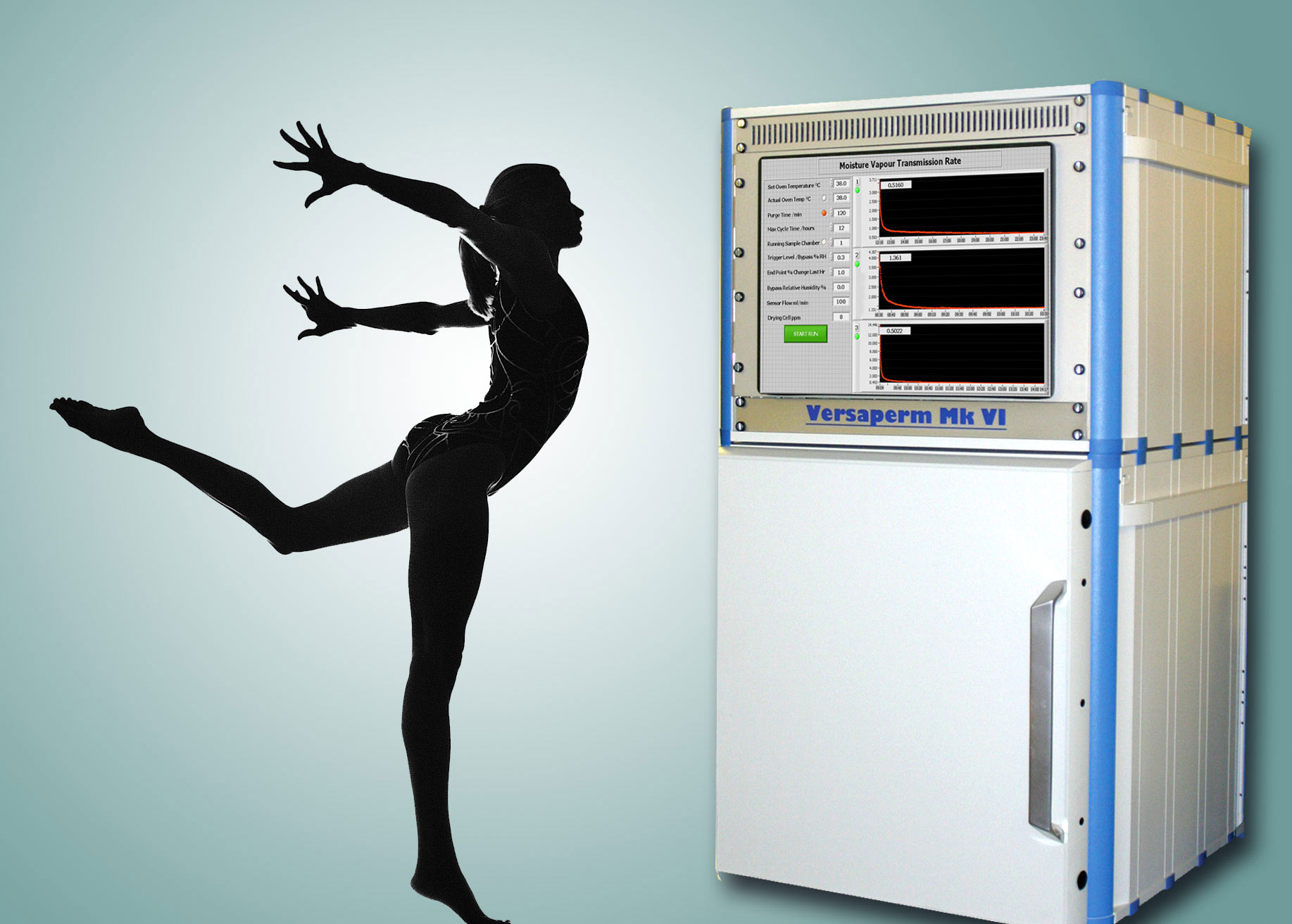
For sensitive Water Vapour, Hydrocarbon, O2, N2, He (and other), vapour permeability testing in the QC or R&D laboratory Our new permeability meter allows your Laboratory to measure the vapour permeability for a wide range of gases, including O2, N2, He, Hydrocarbons gases and water vapour.
 The equipment quickly and reliably measures the permeability
and diffusive flow of vapours across
samples, finished packages, seals, containers, flat samples, equipment etc.
The equipment quickly and reliably measures the permeability
and diffusive flow of vapours across
samples, finished packages, seals, containers, flat samples, equipment etc.
Our permeability meter needs no re-calibration and requires, at most, minimal training to give results that can be as accurate to better than one part per million (with some samples a few parts per hundred million). Sensitivities are in the range 0.05 – 3200g/m2/day depending on the gas, material under test and sensor used.
Its computerised control makes it simple to operate. Additionally we offer a comprehensive permeability laboratory testing service for permeability measurements
Comparison of Typical WVTR’s
| Material | Relative Permeability* |
| Cold Form Foil | 0 |
| CTFE | 0.02 |
| COC | 0.24-0.29 |
| Polychlorotrifuoroethylene (PCTFE or Aclar) | 0.16 |
| Polyvinylidene chloride (PVDC or saran) | 0.2 |
| High-density polyethylene (HDPE) | 1.2 |
| Polypropylene (PP) | 1.6 |
Good Vapour Barrier materials
|
|
| Polyethylene terephthalate (PET) | 5.2 |
| Low-density polyethylene (LDPE) | 4.8 |
Low vapour-barrier materials |
|
| Polyvinyl choride PVC | 16 |
| Acrylonitrile copolymer (Barex) | 20 |
| Polyamide (PA or Nylon) | 100 |
*Best Vapour-barrier materials Relative Permeability based on Polyamide at 100%
Semi-permeable membranes permit certain molecules or ions to pass through them by diffusion (and occasionally by specialized "facilitated diffusion"). Permeability is a measure of the rate of passage through the membrane and depends on the pressure, concentration, and temperature of the molecules or solutes on either side, as well as the permeability of the membrane. This measurement is frequently required has become easy, quick and reliable to measure in the R&D or QC laboratory.
Click here for the Wikipedia article on the permeability of semi-permiable membranes
Click here for a press release on Permeability measurement in the laboratory (R&D)
Click here for an article on permeability measurement